
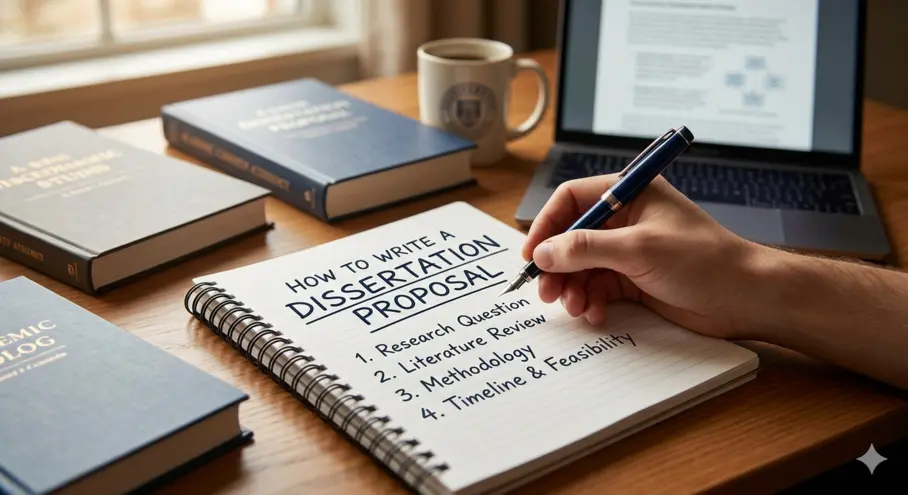
Starting a dissertation begins with one key step: the proposal. It’s the point where your idea is shaped, tested, and judged before it ever becomes a full research project, and it often decides whether your topic moves forward or gets sent back for revision.
A dissertation proposal is not just a summary of what you want to study. It’s where you show that your idea is clear, realistic, and worth researching. When learning how to write a dissertation proposal, this is where everything starts to make sense, not just what you want to do, but why it matters and how it can actually be done.
This guide will walk you through the process in a simple, practical way. You’ll understand how to write a dissertation proposal for Master's and PhD from the start, how each section works, and how to avoid the common mistakes that make students overthink or get stuck early on.
What Is a Dissertation Proposal?
A dissertation proposal is a document that outlines the research you intend to conduct before the full dissertation begins. Think of it as a research plan. It explains the following:
- What do you want to study?
- Why is this topic worth studying?
- What have other researchers already discovered?
- Where and when will you conduct the research?
- Who will you focus on in your study?
- How do you plan to answer your research question?
One of the biggest misconceptions students have is believing that a proposal needs to contain all the answers. It doesn't. Your dissertation is where you'll find and analyze those answers.
This is why learning how to write a good dissertation proposal is so important. A well-written proposal gives your supervisor confidence in your project, helps clarify your own thinking, and provides a foundation that can make the dissertation process significantly smoother later on.
Before You Start Writing
Before worrying about formatting, methodology, or chapter headings, spend time refining your research idea. Many students rush into writing and then discover that their topic is too broad, too narrow, or lacks enough available research.
Ask yourself a few basic questions. What problem, issue, or gap in knowledge interests you? Why is it worth studying? What specifically do you want to find out? If you struggle to answer these questions clearly, it's worth spending more time developing the idea before drafting your proposal.
This early planning stage is often overlooked, yet it has a greater impact on the quality of your proposal than any writing technique. The strongest proposals usually come from students who have spent time thinking carefully about their research direction before writing a single paragraph.
How to Structure a Dissertation Proposal: Best Outline
One of the biggest misconceptions about dissertation proposals is that they need to be complicated. In reality, most successful proposals follow a fairly straightforward structure. The exact format may vary between universities, but the core sections remain largely the same.
A strong dissertation proposal typically includes:
- Introduction
- Research problem or research question
- Literature review
- Methodology
- Research significance
- Timeline
- References
Think of these sections as answers to the questions your supervisor is already asking. What are you studying? Why does it matter? What has already been written about it? How will you conduct the research? And can you realistically complete it within the available timeframe?
When these questions are answered clearly, the proposal becomes much easier to write and much more convincing to read.
The Introduction: Setting the Foundation
Many students spend too much time trying to create the perfect opening paragraph. The truth is that your introduction doesn't need to be dramatic. It needs to be clear.
If you're researching how to write a dissertation proposal introduction, start by explaining your topic and providing enough context for the reader to understand the issue. Then gradually narrow the discussion until you arrive at your specific research problem or question.
A good introduction helps the reader understand three things:
-
What your research is about
-
Why the topic matters
-
What you intend to investigate
By the end of the introduction, there should be no confusion about the focus of your project.
Defining Your Research Question
The research question is often the most important part of the entire proposal. Everything else, the literature review, methodology, and analysis, will revolve around it.
A weak research question is usually too broad or too vague. For example, "How does social media affect students?" could lead in dozens of different directions. A stronger question narrows the focus and identifies a specific issue, group, or context.
The best research questions are clear, focused, and researchable. They should be specific enough to investigate thoroughly while still being significant enough to contribute meaningful insights.
Before moving forward, ask yourself a simple question: can this question realistically be answered within the scope of a dissertation? If not, it may need refinement.
Explaining the Significance of Your Research
At some point, every proposal must answer the question: why does this matter?
This section doesn't require grand claims about changing the world. Instead, focus on the practical, academic, or theoretical value of your research.
Perhaps your study addresses a gap in current literature. Maybe it offers insights that could inform future research, policy, or professional practice. Whatever the case, explain the potential contribution honestly and realistically.
Supervisors are more persuaded by thoughtful reasoning than exaggerated promises.
Writing the Literature Review
The literature review is where you demonstrate your understanding of existing research. Many students mistakenly think this section is about summarizing every article they have read. It isn't.
Instead, the goal is to show how previous studies relate to your topic and where gaps still exist. You're joining an ongoing academic conversation, not simply reporting what others have said.
As you review the literature, look for patterns, disagreements, limitations, and unanswered questions. These observations help justify your own research and explain why your project deserves attention.
A strong literature review tells the reader, "Here's what we already know, here's what we don't know, and here's where my research fits."
How to Write a Dissertation Proposal Methodology
For many students, the methodology section feels intimidating. Fortunately, it is often much simpler than expected.
The methodology explains how you plan to conduct your research and collect information. This section should provide enough detail for readers to understand your approach and determine whether it makes sense for your research question.
When learning how to write a dissertation proposal methodology, focus on explaining:
- What research method you will use
- Why you chose that method
- Who or what you will study
- How data will be collected
- How data will be analyzed
For example, a study exploring personal experiences might use interviews, while research examining trends across a large population may rely on surveys or existing datasets.
There is no universally "best" methodology. The right method is simply the one that helps answer your research question most effectively.
Creating a Realistic Research Timeline
A timeline shows that you've considered the practical side of completing your project. It demonstrates organization and helps reassure reviewers that your research plan is achievable.
Your timeline might include:
- Completing the literature review
- Collecting data
- Analyzing findings
- Writing chapters
- Revising and editing
The goal isn't to predict every detail perfectly. It's simply to show that you've thought through the process and understand the work involved.
Common Dissertation Proposal Mistakes to Avoid
Most proposal problems don't come from poor writing. They come from unclear thinking.
One common mistake is choosing a topic that is far too broad. Students often start with an area of interest rather than a focused research question, which makes the proposal difficult to develop.
Another mistake is neglecting the literature review. If you don't understand existing research, it becomes difficult to explain how your study contributes something new.
Many students also spend too much time trying to sound academic. Complex language rarely improves a proposal. In most cases, clear writing demonstrates stronger understanding than complicated terminology.
Finally, avoid treating the methodology as an afterthought. Even a great research idea can be weakened by an unrealistic or poorly explained research plan.
How Long Does It Take to Write a Dissertation Proposal?
One of the most common questions students ask is how long does it take to write a dissertation proposal.
The answer depends on how developed your research idea already is. If you've already explored the literature and have a clear research question, writing the proposal may take several weeks. If you're still refining your topic, the process can take considerably longer.
In most cases, students underestimate the amount of time needed for reading, planning, revising, and receiving feedback. Writing itself is often only one part of the process.
Rather than focusing on speed, focus on clarity. A well-planned proposal can save months of frustration later during the dissertation itself.
A Quick Note on Dissertation Proposal Examples
Looking at a dissertation proposal example in your specific field is genuinely useful, not to copy structure mechanically, but to calibrate expectations. What does a strong literature review look like in your discipline? How detailed is the methodology for a qualitative study versus a quantitative one?
Here's something no one tells you clearly enough: the best dissertation proposals read like they were written by someone who is genuinely excited about their research question. Not breathlessly enthusiastic, but purposeful. Curious. Committed.