
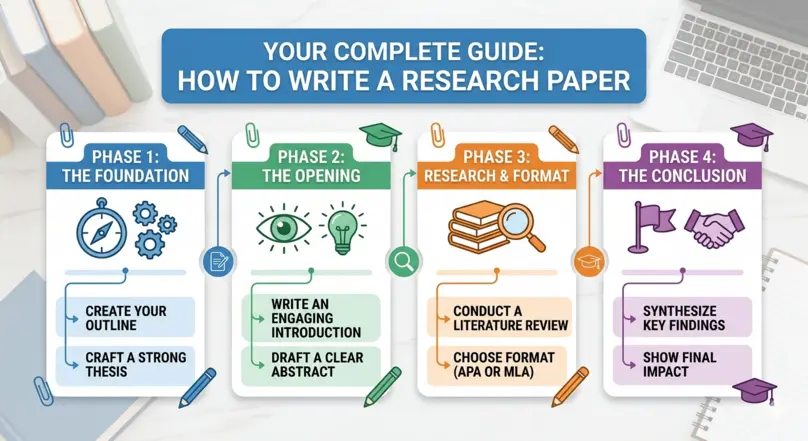
If you are trying to understand how to write a research paper, the biggest mistake is starting without seeing the full structure. A research paper is not written randomly; it follows a predictable system that helps readers understand your argument step by step. Once you understand this structure, even complex topics become manageable.
This guide walks you through how to write a research paper step by step guide using real sections, real writing flow, and practical examples. Whether you are in high school or college, this structure remains the same.
Start With a Clear Understanding of What a Research Paper Is
A research paper is not a summary of everything you read about a topic. That's a common mistake, and it leads to papers that feel scattered and purposeless. A research paper presents an original argument, idea, or finding, and then supports it with credible evidence gathered through research. The goal is to contribute something — a fresh perspective, a synthesis of conflicting studies, a tested hypothesis — not just to report what others have said.
This distinction matters because it shapes every decision you make: what sources you choose, how you structure your argument, and what belongs in your introduction versus your conclusion. Keeping that purpose in mind from the beginning is what separates a B-range paper from one that earns an A — or gets published.
Step 1: Choose and Narrow Your Topic
If your instructor gave you a specific topic, skip ahead. If you have freedom to choose, pick something that genuinely interests you — research is a long process, and curiosity keeps you going when motivation dips. Start broad (climate change, immigration policy, cognitive behavioral therapy) and then narrow until you have a question your paper can realistically answer within its scope.
A workable research topic is specific enough to explore deeply but not so narrow that you can't find sources. "The effects of social media on teenagers" is too broad. "Instagram use and self-reported anxiety in teenage girls between 2018 and 2023" gives you something to actually investigate. That narrowing process is where your thesis begins to take shape.
Step 2: Write a Research Paper Proposal (If Required)
Many instructors — especially at the college level — ask students to submit a research paper proposal before they begin writing. A good proposal outlines your topic, your central argument or research question, your methodology, and a preliminary list of sources. It exists to prove that your project is feasible and that you've thought it through.
Even when a proposal isn't required, writing one for yourself is worth the 20 minutes it takes. It forces you to articulate your direction before you've invested hours in research, which means you can catch problems early. Think of it as a contract you make with yourself about what the paper will do.
Step 3: Conduct Your Research
With a focused topic in hand, it's time to gather sources. For academic papers, you want peer-reviewed journal articles, books from established publishers, government reports, and reputable news sources — not Wikipedia as a final reference. Google Scholar, your library's database, JSTOR, PubMed (for medical topics), and similar platforms are your best tools.
As you read, don't just collect information — look for patterns, disagreements between researchers, gaps in the existing literature, and evidence that supports or complicates your emerging argument. This is also the stage where you write your literature review, which summarizes the existing scholarship and shows where your paper fits into the broader conversation. A strong literature review doesn't just list what others have found; it organizes those findings thematically and critically evaluates their relevance to your question.
Take notes carefully and record your sources as you go. Reconstructing a citation from memory at midnight before a deadline is a special kind of misery you can easily avoid.
Step 4: Build Your Research Paper Outline
Before you write a single paragraph of your actual paper, make an outline. This is the step most students skip, and it's the reason so many papers feel disorganized. Knowing how to write a research paper outline properly is the difference between a paper that flows naturally and one that wanders.
A solid outline maps your main argument and the supporting points that build toward it. A standard structure looks like this:
1. Title Page: Your First Impression Matters
The title page is often ignored, but it is the first formal part of how to write a research paper in APA format or MLA format. It includes your title, name, institution, course, instructor, and date depending on the format required.
A strong title should be specific and informative rather than vague. Instead of writing something general like “Global Warming,” a better title would be “The Impact of Climate Change on Coastal Cities in the 21st Century.” This immediately shows focus and direction.
Even in how to write a research paper high school assignment, the title page sets the tone for your entire work. A clean and properly formatted title page shows professionalism from the beginning.
2. Abstract: The Full Paper in Mini Form
If you are learning how to write an abstract for a research paper, think of it as a compressed version of your entire paper. It is usually 150–250 words and includes your purpose, methods, key findings, and conclusion.
The abstract is written last, even though it appears at the beginning. This is because you cannot summarize what you have not fully written yet. Many students struggle with this part when learning how to write a research paper abstract, but the key is simplicity.
A good abstract does not include citations or deep explanations. Instead, it gives readers a quick overview so they can decide whether to read the full paper.
3. Introduction: Setting Up the Entire Argument
The introduction is one of the most important parts of how to write a research paper introduction because it builds the foundation of your argument. It usually starts broad, narrows down to the specific issue, and ends with your thesis statement.
A strong introduction includes background information, the research problem, and your main argument. If you are learning how to write an introduction for a research paper, avoid jumping directly into details without context.
For example, if your topic is education, you might start by discussing global education trends before narrowing into your specific focus. This structure keeps readers engaged and logically leads them to your thesis.
4. Thesis Statement: The Heart of Your Paper
If you are asking how to write a thesis for a research paper, the answer is simple but powerful: your thesis is your central argument in one or two sentences.
A strong thesis is not a fact; it is something you can argue or prove. For example, instead of saying “Pollution is bad,” a stronger thesis would be “Industrial pollution is the leading cause of urban air quality decline, requiring stricter environmental regulations.”
When learning how to write a thesis statement for a research paper, remember that everything in your paper must connect back to this one idea.
5. Literature Review: Showing What Already Exists
The literature review is often the most misunderstood part of how to write a research paper outline and structure. This section explains what other researchers have already said about your topic.
If you are learning how to write a literature review for a research paper, your goal is not just to summarize studies but to compare them. You should identify patterns, disagreements, and gaps in research.
This section proves that you understand your topic deeply and are not repeating existing work. It also helps justify why your research is necessary.
6. Methodology: Explaining How You Did the Research
The methodology section explains exactly how you collected and analyzed your data. This is a key part of how to write a research paper step by step, especially in scientific and academic studies.
You describe whether you used surveys, experiments, interviews, or secondary data. You also explain why you chose these methods and how they support your research question.
A clear methodology builds trust. Readers should be able to understand and even replicate your study if needed.
7. Results: Presenting the Facts
The results section is where you present your findings without interpretation. This is important in how to write a research paper example because many students confuse results with discussion.
Here, you simply show what you discovered using data, tables, or observations. You do not explain why the results happened yet—that comes later.
Clarity is key in this section. The reader should easily understand what your research revealed without confusion or unnecessary explanation.
8. Discussion: Explaining What the Results Mean
The discussion section is where your analysis comes alive. If you are learning how to write a research paper step by step guide, this is where you connect your findings to your thesis.
You explain patterns, compare results with previous research, and discuss why your findings matter. This is also where you address limitations and unexpected outcomes.
A strong discussion shows critical thinking. It is not just about what you found, but what it means in a broader context.
9. Conclusion: Wrapping Everything Together
If you are wondering how to write a research paper conclusion, think of it as the final summary of your argument. It should restate your thesis in a new way, summarize key findings, and highlight the importance of your research.
A good conclusion does not introduce new information. Instead, it gives closure and leaves the reader with a clear understanding of your message. In how to write a conclusion for a research paper, simplicity and clarity matter more than length.
10. Citations and References: Academic Trust
Citations are essential in how to write a research paper in APA format or MLA format. They show where your information comes from and prevent plagiarism.
APA uses author-date citations, while MLA uses author-page format. At the end of your paper, you include a reference list or works cited page.
This section is critical because without proper citations, even strong research loses credibility. This outline works for most academic levels, including how to write a research paper in high school or college assignments.
11: Format Your Paper (APA, MLA, or Other Style)
Formatting requirements depend on your discipline and your instructor. Knowing how to write a research paper in APA format is essential for psychology, education, and social science students. APA uses in-text citations with the author's last name and year of publication (Smith, 2021), a title page, an abstract, and a References list at the end. Headings are formatted in a specific hierarchy.
MLA format is standard in the humanities — literature, history, philosophy. Knowing how to write a research paper in MLA format means using in-text citations with the author's last name and page number (Smith 47), a Works Cited page, and a specific header and header format on the first page. No title page is required in standard MLA.
How to Write a Research Paper in High School
If you're learning how to write a research paper in high school, the fundamentals are the same as at any level — you just have more room to find your footing. Start by choosing a topic that genuinely interests you. Use your school library's databases for credible sources, not just general web searches. Practice writing a clear thesis statement before you do anything else: if you can't state your argument in one sentence, your topic may still be too vague.
High school research papers are usually shorter and less complex than college papers, but the structure — introduction, body, conclusion, references — is the same. Treat every high school paper as practice for the longer, more demanding work ahead. The students who arrive at college already comfortable with research and citation are the ones who hit the ground running.
What Separates Good Research Papers From Great Ones
The best research papers do something more than follow the format correctly. They enter a real conversation in their field. They treat their sources critically rather than accepting every claim at face value. They acknowledge their own limitations honestly. They write for a reader, not just for a grade — which means every sentence is there because it carries the argument forward, not because it pads the word count.
Read your final draft out loud before you submit it. You'll catch awkward sentences, logical gaps, and transitions that don't work in ways that silent reading misses. Revise until the paper says exactly what you mean, in as few words as possible, with evidence that does real work. That's how to write a research paper that stands out — and that standard applies whether you're a high school freshman or a doctoral candidate.
Need help with your research paper? Our top writer are available to guide you through every step — from choosing a topic to final formatting.