
Formatting academic papers can feel like trying to solve a puzzle where the pieces change shape depending on the work. One semester you are mastering the art of the footnote, and the next, your professor is demanding parenthetical citations with page numbers.
Here's the thing: citation styles aren't arbitrary. Each one was built for a specific kind of writing and a specific audience. They help readers trace your sources, verify information, and understand where your ideas come from. Once you understand that, the confusion clears up fast.
APA, MLA, Harvard, and Chicago styles dominate the academic world, but they serve completely different purposes.
The Big Three: Who Uses What?
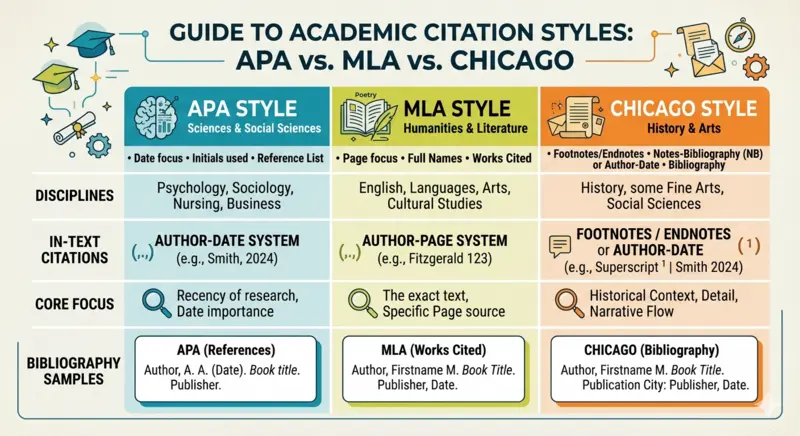
The easiest way to understand APA vs. MLA vs. Chicago styles is to look at the academic disciplines that created them. Each style is tailored to the specific way researchers in those fields think and evaluate information.
-
APA (American Psychological Association): This style is the gold standard for the Sciences and Social Sciences. If you are writing about psychology, sociology, nursing, business, or economics, you will use APA.
-
MLA (Modern Language Association): This style is built for the Humanities. It is what you will almost always use in English literature classes, cultural studies, foreign languages, and theater.
-
Chicago Manual of Style: This is the preferred choice for History and some art sciences. It is famous for its comprehensive look and its use of footnotes at the bottom of the page.
A properly formatted paper shows attention to detail and academic integrity.
When to Use APA vs MLA vs Chicago
This is probably the most searched question on the topic, and the answer is simpler than most guides make it.
Use APA when:
-
You're writing in psychology, sociology, education, nursing, or any social or behavioral science
-
Your argument depends on research findings and publication dates matter
-
You're writing a lab report, research paper, or literature review
Use MLA when:
-
You're in an English, literature, film, or cultural studies class
-
Your paper analyzes a text, an author's work, or a cultural artifact
-
Page numbers matter more than publication years
Use Chicago when:
-
You're writing history, philosophy, or fine arts
-
You're working with primary sources, archives, or footnotes
-
You're writing a book, thesis, or anything that needs detailed source commentary
If your professor hasn't specified, ask. If you can't ask, use APA for science, MLA for humanities, and Chicago for history or research involving older sources.
APA vs MLA vs Chicago Citation Differences
|
Style |
Common Subjects |
In-Text Citation |
Reference Page |
Example |
|---|---|---|---|---|
|
APA |
Psychology, Education, Business, Social Sciences |
Author, Year |
References |
Students learn better through repetition (Smith, 2024). |
|
MLA |
Literature, Arts, Humanities |
Author, Page Number |
Works Cited |
Students learn better through repetition (Smith 25). |
|
Chicago |
History, Publishing, Humanities |
Footnotes or Author-Date |
Bibliography |
Students learn better through repetition.¹ |
The biggest difference lies in how sources are cited within the text and how references are listed at the end.
APA Format
-
Title page required
-
Double-spaced
-
1-inch margins
-
References page
-
Running head may be required
APA In-Text Citation Example
A citation appears like this:
(Smith, 2024)
Or:
Smith (2024) argues that effective study habits improve academic performance.
APA Reference Example
Smith, J. (2024). Academic success strategies. Academic Press.
Key APA Features
-
Uses author-date citations
-
Includes a References page
-
Requires a title page in most cases
-
Uses running heads in some academic papers
-
Emphasizes publication dates
MLA Format
-
Student information in upper left corner
-
Double-spaced
-
1-inch margins
-
Works Cited page
-
Page numbers in header
MLA In-Text Citation Example
(Smith 25)
Or:
Smith argues that study habits influence performance (25).
MLA Works Cited Example
Smith, John. Academic Success Strategies. Academic Press, 2024.
Key MLA Features
-
Uses author-page citations
-
Includes a Works Cited page
-
No title page unless requested
-
Focuses on authorship and page numbers
-
Common in humanities courses
Thus, the primary difference between APA vs MLA in-text citation is that APA uses the author's name and publication year, while MLA uses the author's name and page number.
Chicago Format
-
Title page often required
-
Double-spaced
-
Footnotes throughout paper
-
Bibliography page
Chicago Footnote Example
The sentence appears normally, followed by a superscript number.¹
Footnote:
¹ John Smith, Academic Success Strategies (New York: Academic Press, 2024), 25.
Chicago Bibliography Example
Smith, John. Academic Success Strategies. New York: Academic Press, 2024.
Key Chicago Features
-
Uses footnotes or endnotes
-
Includes a bibliography
-
Provides detailed source information
-
Common in historical research
Harvard Citation Style
Many international universities also use Harvard referencing. Like APA, Harvard relies on author-date citations.
Harvard Example
In-text:
(Smith, 2024)
Reference:
Smith, J. 2024, Academic Success Strategies, Academic Press.
Key Difference - APA vs MLA vs Chicago vs Harvard
Harvard and APA look similar, but formatting rules vary slightly depending on institutional guidelines.
When comparing APA vs MLA vs Chicago vs Harvard, Harvard sits closest to APA, while MLA and Chicago remain distinct.
Common Citation Mistakes Students Make
Regardless of style, these mistakes happen frequently:
-
Mixing citation styles in the same paper
-
Forgetting page numbers when required
-
Inconsistent formatting
-
Missing sources in the reference list
-
Incorrect punctuation
-
Using outdated style guidelines
Always double-check your instructor's requirements before submitting your work.
A Quick Decision Guide
Still not sure which one to use? Run through this:
-
Is this a psychology, education, or social science paper? → APA
-
Is this a literature, film, or cultural studies paper? → MLA
-
Is this a history paper or something using primary sources? → Chicago (Notes-Bibliography)
-
Is this a social science paper at a UK institution? → Chicago (Author-Date) or Harvard
-
Did your professor specify? → Use that one, no matter what
The Bottom Line
APA, MLA, and Chicago aren't competing for the title of "best citation style." They're tools for different jobs. APA centers the year because currency of research matters in science. MLA centers the page because the text is the point in literature. Chicago centers the complete source information because historians and scholars need to trace every thread back to its origin.
Understanding APA vs MLA vs Chicago citation doesn't have to be complicated. Get all the solutions you need from our verified paper waters.